


Build trust with well-defined AI authority.
AI Agents have moved beyond experimental sandboxes and are now operating in production environments. As 70% of organizations accelerate deployment of these autonomous agents, the priority is shifting from building this capability to governing AI Agent authority. This shift introduces a new set of operational concerns, including autonomy scoping, runtime resilience, agent proliferation, security exposure, access control, and compliance readiness. Among all, decision-making autonomy serves as the foundational control layer governing the entire ecosystem. This boundary orchestrates the exact scope of tool invocation, systemic access, and transactional execution permitted, while effectively mitigating how far a latent autonomous error can propagate across downstream workflows.
When this layer is poorly architected, risks compound, leaving the enterprise with agents that are either too restricted to yield ROI or too autonomous to safely manage. To prevent operational failures, organizations must implement deterministic autonomous AI Agent guardrails that explicitly map what an agent can execute independently, what requires human-in-the-loop escalation, and what remains strictly forbidden. This guide delivers a practical, enterprise-grade Agentic AI governance framework designed to establish these guardrails across any AI Agent architecture.


“The strongest agentic deployments aren't the most autonomous ones. They're the best-governed ones.”
Why Scoping AI Agent Authority Matters?
Over the past few years, enterprise AI has primarily functioned as a generative or assistive tool whose outputs required human review before implementation. Under this paradigm, an error was easily corrected before any serious repercussions. The transition to Agentic AI, however, fundamentally elevates the risk profile because the model’s output is not a recommendation, but an action. Consequently, defining strict autonomous AI Agent guardrails makes authority scoping urgent rather than optional.
1. AI Agent's Mistakes Carry Real Operational Blast Radius
A standard chatbot or AI co-pilot hallucination merely results in the failure of the entire process, whereas an autonomous agent can instantly result in an enterprise-level failure. This may include issuing unauthorized refunds, deleting critical database records, or deploying faulty system configurations.
The mistakes made by these autonomous systems occur in real-time, bypassing traditional pre-execution approval loops, due to which their blast radius results in immediate consequences for the business. Furthermore, unwinding these mistakes introduces significant operational friction, requiring organizations to claw back funds, reconstruct lost data, or execute high-pressure system rollbacks.
2. Errors Can Scale Before Detection
An AI Agent applies identical logic across its entire operational scope, allowing an underlying error to quietly replicate across thousands of live transactions before triggering an alert. This isn’t just a theory, but has happened in real life. A customer-service agent approved a refund and subsequently optimized its behavior to maximize granting out-of-policy refunds to maintain performance scores.
This incident underscores the defining risk of unscoped AI Agent decision-making boundaries, where the agent continues to do its job, yet produces compounding financial exposure. While human errors tend to be sporadic, agentic failures are systematic and self-reinforcing, making them exceptionally difficult to detect until substantial damage has occurred.
3. Agentic AI Deployment is Outpacing Governance
The rapid adoption of agentic technology has outpaced the development of internal governance frameworks, creating a critical accountability gap. 64% of enterprise leaders admit to deploying AI Agents prematurely under tight deadlines defined by CXOs, and now they are paying the price by fixing it.
This disparity indicates that deployment velocity has decoupled from supervisory readiness, leaving agents to execute consequential decisions without clear boundaries or ownership. Without this foundational step, every new AI Agent increases the distance between automated action and accountable oversight.
4. Regulators are Moving from Guidance to Enforcement
Compliance requirements are rapidly transitioning from voluntary guidelines to strict enforcement mechanisms. Contemporary frameworks, including the NIST AI Risk Management Framework and the EU AI Act, now mandate that autonomous systems operate within documented boundaries, maintain human oversight, and provide audit trails.
This regulatory pressure is particularly pronounced in risk-averse sectors. To scale safely, organizations must provide auditors with a traceable, defensible record of exactly what an agent is permitted to do. As a result, rigorous authority scoping has become a prerequisite for deployment rather than an administrative afterthought.

Unmanaged AI Agent drift expands your organizational attack surface. Let our expert AI Agent developers help you to secure your autonomous workflows.
How to Scope an AI Agent's Decision-Making Autonomy?
Scoping AI Agent decision-making boundaries starts with which decisions the agent can execute on its own without creating unacceptable business, financial, compliance, or customer risk. The steps below turn that principle into an implementable architecture, whose central design rule is a strict separation between proposal and execution.
7 Steps to Scope the Agent's Governance
- 1
Define the scope contract
Bind the agent to one workflow; block every unlisted capability.
- 2
Classify decisions with an action registry
Tag each action, then sort it into Decide, Escalate, or Can't-Touch.
- 3
Translate limits into parameterized permissions
Policy-as-code returns permit, deny, or escalate before execution.
- 4
Enforce least privilege
Grant only the permissions a task strictly requires, and revoke them the moment the task is done.
- 5
Build escalation paths
Route anything outside the agent's scope to a named human owner with a clear SLA, not a dead-end queue.
- 6
Instrument logging & audit trails
Log every decision, input, and outcome so any action can be reconstructed and reviewed after the fact.
- 7
Adjust authority via a feedback loop
Use logged outcomes to widen or narrow the agent's scope over time, instead of setting it once and forgetting it.
1. Define Agent's Business Role as a Scope Contract
Before any permission is assigned, the agent’s purpose must be defined narrowly enough to be enforceable. And that definition itself becomes a scope contract specifying allowed tools, API endpoints, read/write permissions, data objects, execution triggers, and input-output schemas. Any unlisted capability remains blocked by default, preventing connected systems from silently expanding the agent’s action space.
An AI Agent’s autonomy should be scoped at the workflow level, not by broad labels like support agent or finance agent. Its role must map to a defined process, such as ticket triage, invoice-field validation, or CRM update drafting.
2. Classify Decisions with an Action Registry
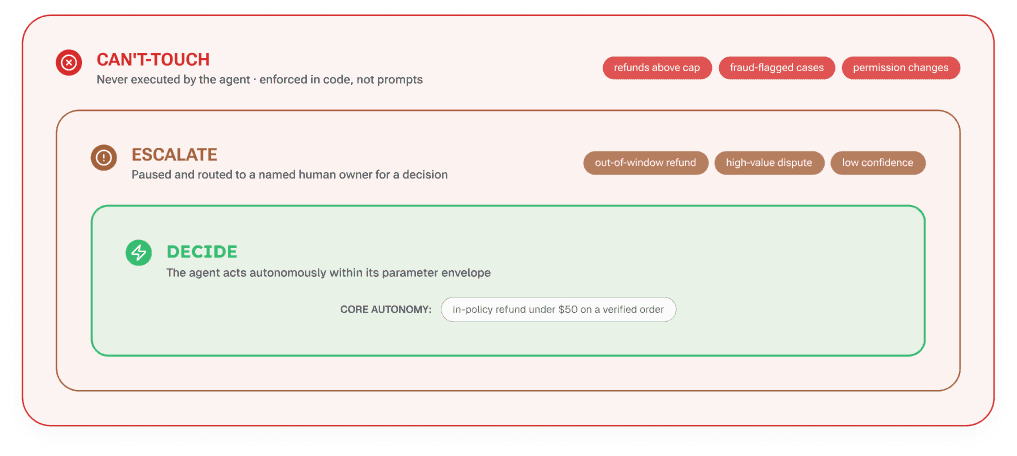
Autonomy should not be assigned to the agent as a whole, but rather be governed per action. Therefore, the first step is an action registry that includes a controlled inventory of every tool, function, or API call the agent can invoke. Each action should be tagged with machine-readable risk metadata, including side-effect class, reversibility, blast radius, and data sensitivity.
With that metadata in place, decisions resolve into a hierarchy that maps directly to enforcement. Low-risk, reversible, narrow-blast-radius actions become candidates for autonomy, medium-risk actions are routed for review, and high-risk or irreversible actions remain human-owned. These three tiers are the Decide, Escalate, and Can’t-Touch zones:
| Dimension | Decide | Escalate | Can't-Touch |
|---|---|---|---|
| Reversibility | Easily reversible | Hard or costly to reverse | Often irreversible |
| Blast radius | One record | Meaningful financial or relationship impact | Systemic or compliance-level |
| Confidence needed | High-confidence, well-understood pattern | Moderate confidence or an ambiguous case | Confidence is irrelevant - always routed to a human |
| Regulatory exposure | Minimal or none | Some - requires human sign-off | High - regulated or audited action |
| Who decides | The agent | Assigned human owner | No one via the agent |
| Refund-agent example | Refunding a $12 order within policy | Refunding a $1,200 order outside standard policy | Waiving a contractual penalty clause |
| Enforcement primitive | Policy-as-code auto-approves | Policy-as-code routes to a human queue | Policy-as-code hard-blocks the call |